When the United States invaded Iraq in 2003, its primary goal, as stated by George W. Bush, was to find and destroy any and all weapons of mass destruction stockpiled by Saddam Hussein. In the years since, not a single hitherto-unknown threat has been uncovered. While Iraq may arguably be better off without its dictator, the country’s heritage has suffered and borne a heavy load of bombings. Central to the American campaign was the Iraqi capital of Baghdad, which was stormed by Marines early on in the war.
All in all, the United States made quick work of Hussein’s elite troops and anti-aircraft batteries. And, for the most part, sites of archaeological and historical importance were left intact, spared by forethought and the caution of high-level officials. Marines were given instructions to avoid the National Museum of Iraq, home to a treasure trove of ancient artifacts, Islamic texts, and hardly-decipherable manuscripts.
 |
| National Museum of Iraq (facade) |
Unfortunately, with war being what it is, the Museum was abandoned on April 8th of 2003 by facility staff and taken over by Iraqi forces. For the next two days, the US Third Infantry Division swapped bullets with the museum’s new caretakers, eventually forcing out the last of Hussein’s snipers and ground-troops. With the firefight over and further loss of life averted, looters began to move into the compound, snatching up valuables and making off with masks, friezes, and thousand-year old vases. One team of thieves even managed to steal a 4,400-year old headless statue of the Sumerian king Entemena, which weighed hundreds of pounds and was recovered some time later in the United States.
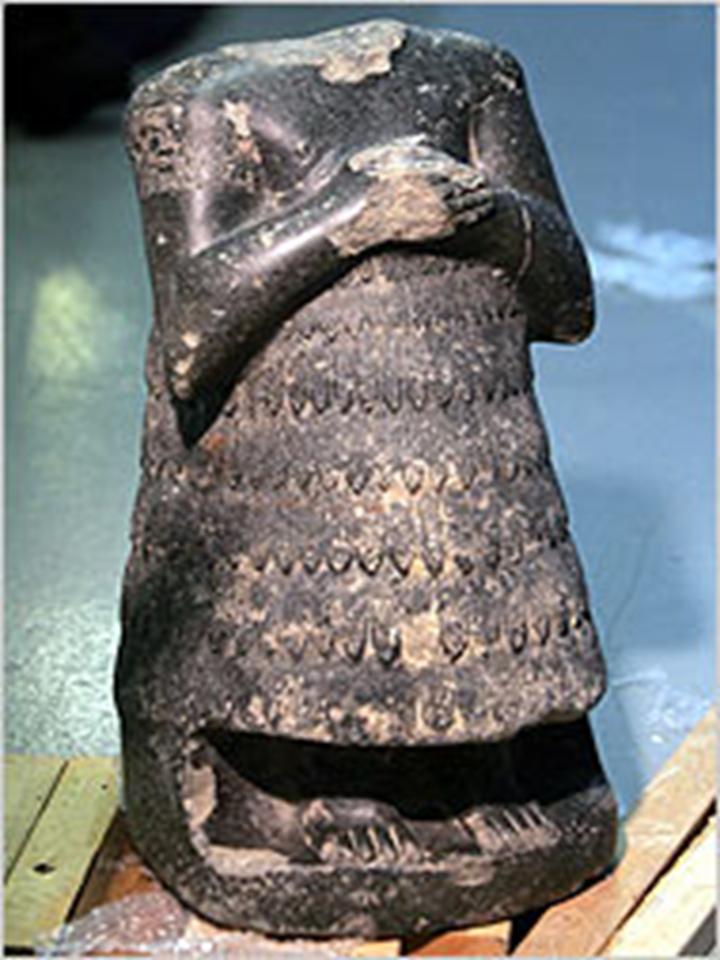 |
| Statue of Entemena |
Despite the best efforts of returning museum staff, over 15,000 unique items were stolen from galleries between April 10th and 12th. The United States Armed Forces suffered severe criticism on an international stage, having perhaps rightly been more focused upon preventing casualties than safeguarding artifacts. While a good number of items have been returned to the NMI since 2003, similar and irreparable damages were levied upon other archaeological sites, both in Baghdad and abroad.

I really enjoy your topic for this blog. I had not even thought about the effect the war in Iraq had on the area’s museums, artifacts and historical culture. Though I do not know why it never occurred to me, it is an area with one of the longest and richest histories.
ReplyDeleteThis post also relates back to the lecture a few days ago about looting. Unfortunately, in a war-torn country the lure of the antiquities market and the money there is large. After hearing how easily some of the artifacts can be illegally sold, I do not think the museum will ever fully recover their collection, sadly.
While I understand why the U.S. has been criticized I think thing could have been much worse in that situation. It is one of the few times the military will be criticized for being focused on saving lives right? How dare they care about peoples’ lives! I am very interested to see what more you find on this topic.